Before You Compare Prices, Compare What You're Actually Buying
A trackless train that carries paying guests is not a commodity purchase. The price difference between a certified unit and an uncertified one does not disappear. It transfers — to you, as the operator.
When a trackless train is significantly less expensive than a Wattman train, that difference reflects specific choices made during manufacturing.
Lower-grade components that meet no recognized safety standard. No independent certification, or certification self-declared by the manufacturer with no outside engineer involved. No after sales infrastructure. No support once the unit ships.
Those choices reduce the manufacturer’s cost. They do not reduce your operating risk. They transfer it.
When you purchase that train, especially when you import it directly, you become the responsible party for everything the manufacturer chose not to do.
Under U.S. federal law, when you purchase and import a product from a foreign manufacturer and place it into commercial use, you step into the legal position of the manufacturer.
When that foreign manufacturer cannot be reached through U.S. courts, and most cannot, the liability for that certified trackless train operation lands on you.
Foreign manufacturers’ insurance policies do not cover U.S. claims. Even if your supplier provides a certificate of insurance, it will not respond when an incident happens on U.S. soil.
In 44 states, operating a commercial trackless train triggers mandatory requirements before you can run a single guest: minimum insurance coverage levels, annual inspections by a certified inspector, written operating permits, and documentation on file with your state authority.
If an incident occurs, your insurer will look for the certification documentation. If it is not there, that is the clause in your policy that ends the conversation.
Source: IAAPA / ASTM International. The six states without amusement ride oversight are Alabama, Mississippi, Montana, Nevada, Wyoming, and Utah.
"I've Never Had a Claim" Doesn't Mean You're Covered
Most operators running an uncertified trackless train in the U.S. have never had an incident. They take that as a sign that everything is fine. It is not a sign of anything.
No incident means the liability has not been tested yet. It does not mean the liability is not there. The day something goes wrong is not the day to find out that your policy excludes non-compliant equipment. That exclusion was in your policy from day one.
When an incident occurs, three things happen at the same time: your insurer reviews your paperwork, your state authority reviews your operating permits, and your personal liability becomes the central question. Not your business. You personally.
Operators who have run uncertified equipment for years without a problem are not protected. They are lucky, and luck runs out.
Three Questions to Ask Any Supplier Before You Move Forward
These are the questions that determine whether you are actually protected, not just on paper, but when it counts.
Was this train certified by an independent third-party engineer?
Self-certification means the manufacturer wrote their own safety report. No outside engineer checked the work. Your insurer and your state authority will ask who signed off on the unit. The answer matters.
Many manufacturers claim their European or other certifications are equivalent to U.S. ASTM standards. None has ever submitted an independent side-by-side comparison to back that up.
Does the full technical file exist and can it be produced on request?
This is the engineering documentation behind the unit: structural calculations, material specifications, load analysis, and inspection records. Most manufacturers who certify their own equipment do not have this file in a form that holds up to outside scrutiny.
Without it, getting the unit independently verified after the fact is either impossible or very expensive, and that problem stays with you, not the manufacturer.
Is there a real service and parts operation in your region?
Or does your train sit idle while you wait weeks for a response from overseas? After sales support is not an extra. It is what keeps your train compliant and earning revenue year after year, not just in the first season.
If any of these answers is unclear before you move forward, the risk is already present.
One Independent Certification. Verified by Real Engineers. Valid Everywhere.
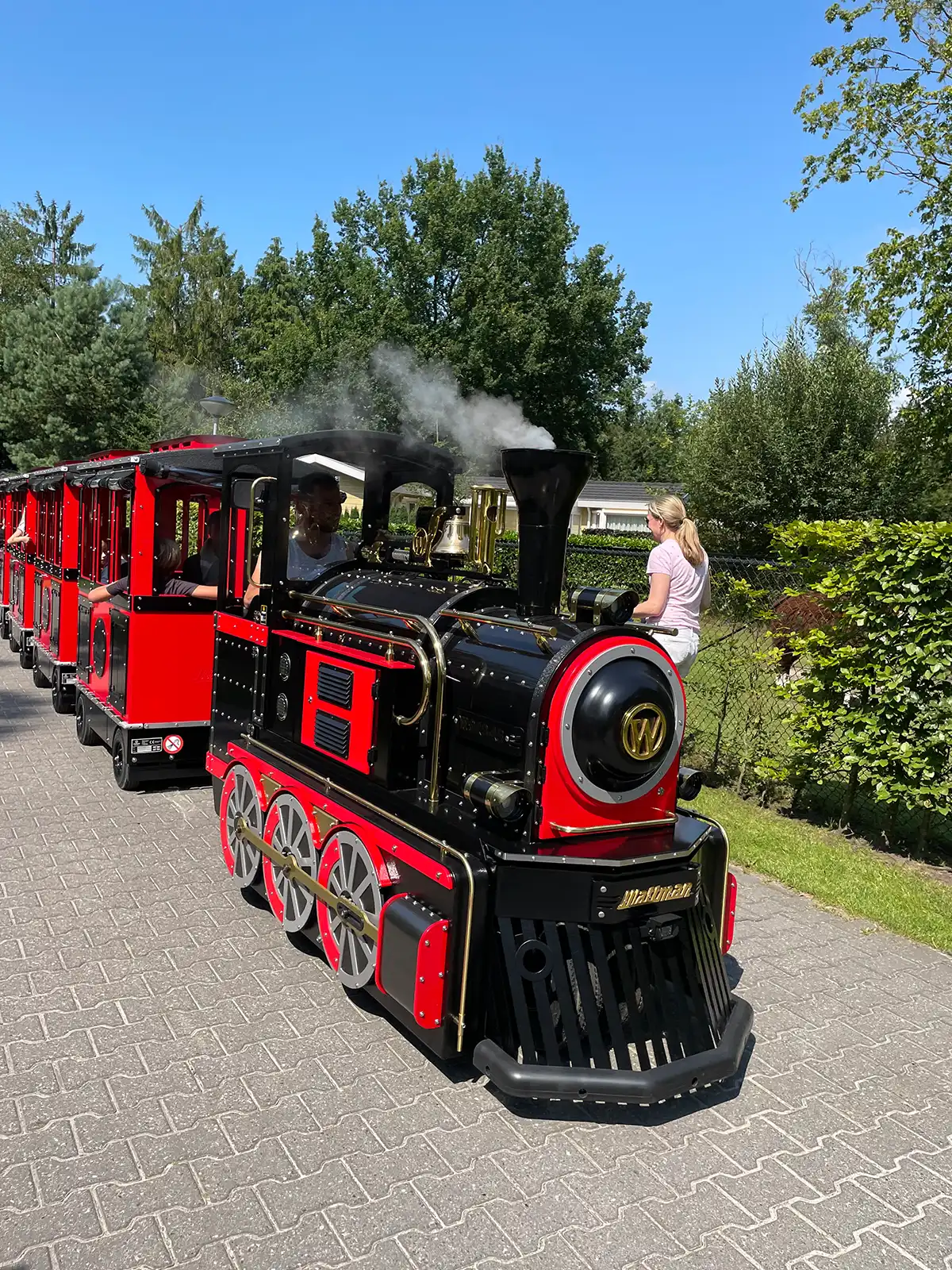
Every Wattman Mini Express and Maxi Express has been independently reviewed and certified by TÜV Nederland, part of the TÜV NORD GROUP, one of the world’s most recognized independent technical inspection organizations.
TÜV Nederland’s Amusement Rides and Devices department did not just review paperwork. Their engineers ran independent structural calculations, verified stability under load, and checked critical components for long-term fatigue, then signed off on the result.
That certification confirms both trains meet EN 13814:2019 Parts 1, 2, and 3, the full European standard covering design, manufacture, operation, maintenance, and inspection. EN 13814:2019 is harmonized with ASTM F2291 and ASTM F1193, the U.S. standards that 44 states reference for amusement ride compliance.
Included With Every Wattman Train
TÜV Nederland certification to EN 13814:2019 Parts 1, 2, and 3, independently issued, covering design, manufacture, and construction. Conforming to ASTM F2291 and ASTM F1193 for U.S. operation. Serial compliance plate installed on the train. Full inspection records and compliance declarations.
The Complete Technical File
Structural calculations, material specifications, load analysis, and inspection records, maintained and available on request. With engineering support from our team in Florida and Texas whenever your insurer or state authority needs it. This is the documentation that holds up when it counts.
Parts and Support That Keep You Operating
Complete operator documentation for your state permit application and annual inspection cycle. Parts and technical support from Florida and Texas throughout your operating life. This is what keeps your train compliant and earning revenue year after year, not just in the first season.
Frequently Asked Questions — Certified Trackless Train USA
What makes a trackless train legally certified for U.S. operation?
For U.S. operation, a commercial trackless train must conform to ASTM F2291 and ASTM F1193 — the standards developed by ASTM International’s F24 Committee for amusement ride design and manufacturing. In 44 states, these standards are referenced in mandatory operating requirements covering insurance, annual inspections, and operating permits.
Is CE certification enough to operate a trackless train in the United States?
No. CE marking satisfies European market access requirements but does not fulfill U.S. ASTM compliance requirements. For U.S. operation, rides must conform to ASTM F24 standards, which requires additional third-party engineering review and inspection by accredited bodies in North America, even when CE documentation exists.
What is the difference between self-declared and independently certified?
Self-certification means the manufacturer wrote their own safety report. No outside engineer reviewed the work. Independent certification means an accredited third-party body such as TÜV Nederland conducted structural calculations, load analysis, and component verification before issuing a certificate. Your insurer and state authority will ask who signed off on the train. The answer determines whether your coverage applies.
How long does approval take?
Most approvals are completed within 2 business days. In straightforward cases, same-day approval is possible.
Can I finance multiple trains or future expansions?
Yes. Operators adding a second train or expanding to a new location can apply for additional financing. Your existing financing history with our partners works in your favor.
The Right Decision Starts With the Right Questions
We are not asking you to move forward with Wattman today.
We are asking you to verify, with any supplier you are considering, that those three questions have clear, documented answers ready to produce when requested.
If they do not, you already know what that means.
If you want to see exactly what a complete TÜV-certified compliance package looks like, we are happy to walk you through it.