
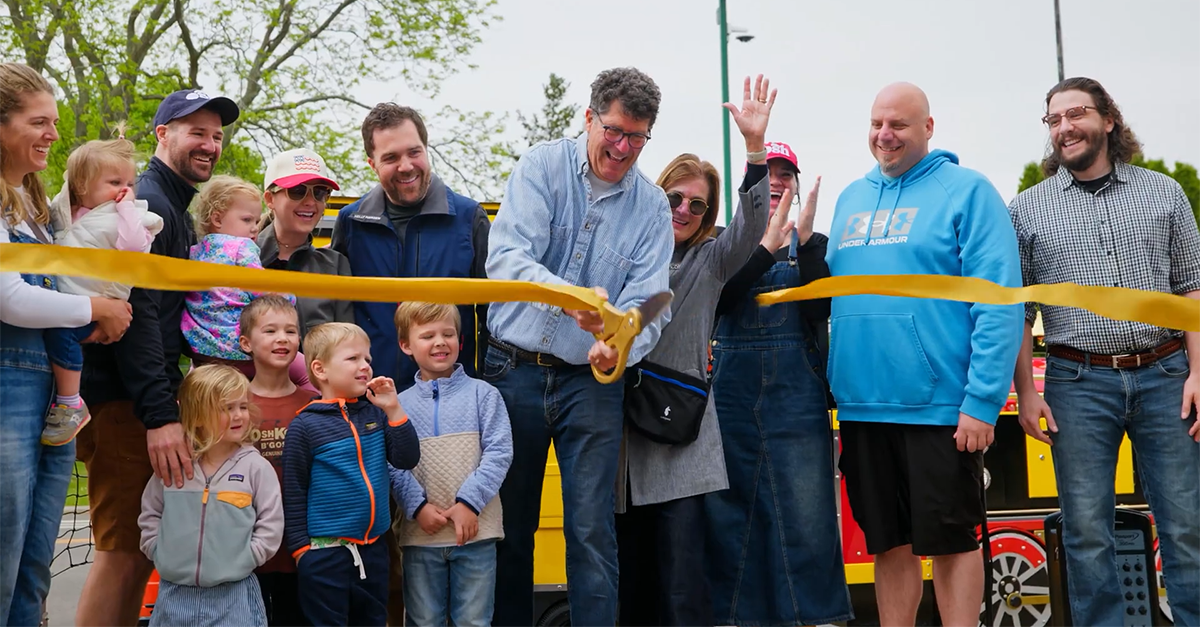
A beloved park train was headed for closure. The city chose a different path, and the attraction now runs seven days a week.
The story of Menominee Park in Oshkosh, Wisconsin is worth reading carefully. Not because it is extraordinary, but because it is not. The same decision is sitting on the desks of parks directors, zoo managers, and venue operators across the country right now. An attraction that guests love has grown too expensive to keep running in its current form. The numbers no longer work. And the venue is left choosing between a hard exit and a harder rebuild.
Oshkosh chose to rebuild. Here is what that looked like, and what it produced.
A Tradition That Almost Ended
For generations, the train at Menominee Park was a fixture. Families rode it. Children grew up on it. It was the kind of attraction that does not just bring people to a park. It becomes the reason people return.
But the original train ran on fixed tracks, and over time the cost to maintain that infrastructure became unsustainable. The city ran the numbers and concluded the old setup could not continue. The attraction was on a path to retirement.
That outcome is more common than most venues acknowledge publicly. A ride that draws visitors stops making financial sense, and the instinct is to quietly wind it down. Oshkosh nearly did the same.
The Community Changed the Calculus
Then residents made their position clear. Public feedback to the Common Council showed how much the train mattered to the community. As one local reporter observed, the train had become part of the fabric of Oshkosh. The Council listened. Rather than remove the attraction, the city looked for a better way to deliver it.
That shift in framing matters. The question stopped being "can we afford this" and became "what is the right version of this." It is a question worth asking at any venue before an attraction is retired.
What is a generational tradition worth to the people who built your audience? And what does it cost, in reputation and return visits, to let one disappear without a fight?
The Wattman Maxi Express Solution
The City of Oshkosh selected a Wattman Maxi Express Signature Edition, an electric trackless attraction train supplied by Wattman USA. The choice addressed multiple problems in a single decision.
The train requires no rails. It operates on the park's existing paved paths, which eliminated the need to repair or replace aging track infrastructure. That single factor removed the largest recurring cost from the equation. No tracks means no track maintenance budget.
The route expanded as well. The new train runs approximately fifteen minutes and winds through the adjacent zoo and across the park, giving riders a complete tour rather than a short loop. Onboard audio narrates the history of the park, turning a family ride into an interpretive experience. The Maxi Express in this configuration seats up to 24 riders and is independently certified to ASTM F2291 and ASTM F770, the recognized US standards for amusement rides.
How the Funding Came Together
Oshkosh did not absorb the full investment through a single budget line. The city built a public-private partnership that distributed the cost across multiple stakeholders. The Oshkosh Community Foundation, Discover Oshkosh, and the WHW Oshkosh B'Gosh Foundation each contributed to offset the initial investment. On opening day, the Wyman family sponsored complimentary rides for all visitors in the park.
This model is replicable. Community foundations, local business partnerships, and tourism organizations frequently have interest in funding durable public attractions, particularly those tied to family experience and long-term visitation. The key is presenting the train as infrastructure for community engagement, not a budget line item for discretionary spending.
For private venues, Wattman USA offers a parallel path through established US equipment finance partners. The structure changes. The principle does not.
The Operational Results
The ribbon cutting took place on May 23, 2026. The train now runs seven days a week through Labor Day, from 11 AM to 6 PM on weekdays and 10 AM to 6 PM on weekends and holidays, with approximately three departures per hour from a station behind the Lake Fly Cafe.
Deputy mayor and council members described the project as an investment in families and recreation. Council member Joe Stevenson called it "really a community driven effort" and noted he looked forward to riding it with his children for decades to come.
The parks department expects maintenance costs to run lower than the system the Maxi Express replaced. That projection is what made the attraction financially viable long-term, not just on opening day.
What Makes a Trackless Train Viable for Municipal Parks
The Oshkosh outcome rested on four operational advantages that apply across similar venues.
| Factor | Tracked Train | Wattman Trackless |
|---|---|---|
| Infrastructure cost | Ongoing track maintenance | Runs on existing paths |
| Route flexibility | Fixed by rail layout | Route adjustable by season or event |
| US certification | Varies by equipment age | ASTM F2291 + ASTM F770 |
| Guest experience | Loop of fixed length | Extended tour, onboard audio |
| Power source | Typically diesel or gas | Fully electric, zero emissions |
None of these advantages are specific to Oshkosh. A zoo, a regional park, an amusement destination, or a municipal parks department operating any tracked ride with rising maintenance costs faces the same set of variables. The decision Oshkosh made is available to any venue willing to reframe the question.
What This Means for Your Venue
The Oshkosh story is not about a city park. It is about a decision point that most venues with legacy attractions will reach. An aging ride, a community that values it, and a budget that cannot sustain the current version of it. That is a solvable problem.
A trackless train eliminates the infrastructure dependency. It extends the route. It runs on electricity. And it arrives certified to the standards US parks and insurance providers expect. The attraction does not change in the eyes of the guest. The cost structure changes in the eyes of the operator.
Is there a tradition at your venue worth protecting, and is the current version of it costing more than it should to maintain?
Frequently Asked Questions
Can a trackless train replace a tracked park train?
Yes. A trackless train operates on existing paved paths and requires no rails, no track bed, and no fixed infrastructure. The transition from a tracked system to a trackless one removes the ongoing cost of track maintenance while preserving the ride experience guests expect. The Wattman Maxi Express is a direct functional replacement for most tracked park train attractions.
How much does it cost to maintain an electric trackless train at a city park?
Electric trackless trains carry lower maintenance costs than diesel or gas-powered tracked systems for two reasons: no track infrastructure to service, and significantly fewer moving mechanical parts in an electric drivetrain. The City of Oshkosh expects its Wattman Maxi Express to cost less to maintain than the system it replaced. Exact figures depend on usage intensity, local service availability, and operating season length. Wattman USA can walk through realistic operating cost estimates during a consultation.
What certifications does a park train need to operate in the United States?
In the United States, amusement ride trains are typically evaluated against ASTM F2291 (Standard Practice for Design of Amusement Rides and Devices) and ASTM F770 (Standard Practice for Ownership, Operation, Maintenance, and Inspection of Amusement Rides and Devices). The Wattman Maxi Express is independently certified to both standards. Operators should also verify any state or county-level inspection requirements applicable to their jurisdiction, as these vary.
How do city parks fund a new attraction train?
Several paths are available to public parks. Community foundations, local business sponsors, and tourism promotion organizations have funded trackless train acquisitions as part of broader park investment initiatives, as Oshkosh demonstrated in 2026. Federal and state recreation grant programs including LWCF and state park improvement funds may also apply depending on the project scope. For private venues, Wattman USA works with established US equipment finance partners to structure the investment over time.
How long does a trackless train ride last at a public park?
Ride duration is determined by the operator and the route chosen. The Menominee Park installation runs approximately fifteen minutes, covering the park grounds and the adjacent zoo. Wattman trackless trains are not route-constrained by fixed rails, so operators can design a circuit that fits their grounds, visitor expectations, and operating schedule. A fifteen-minute round trip at three departures per hour is a common starting point for parks with comparable footprints.
Operators across the US have made the same transition Oshkosh did.
If your venue has an aging attraction that deserves a better version of itself, we are glad to walk through the options with you.
Explore the Maxi Express Schedule Your Wattman Expert Consultation