
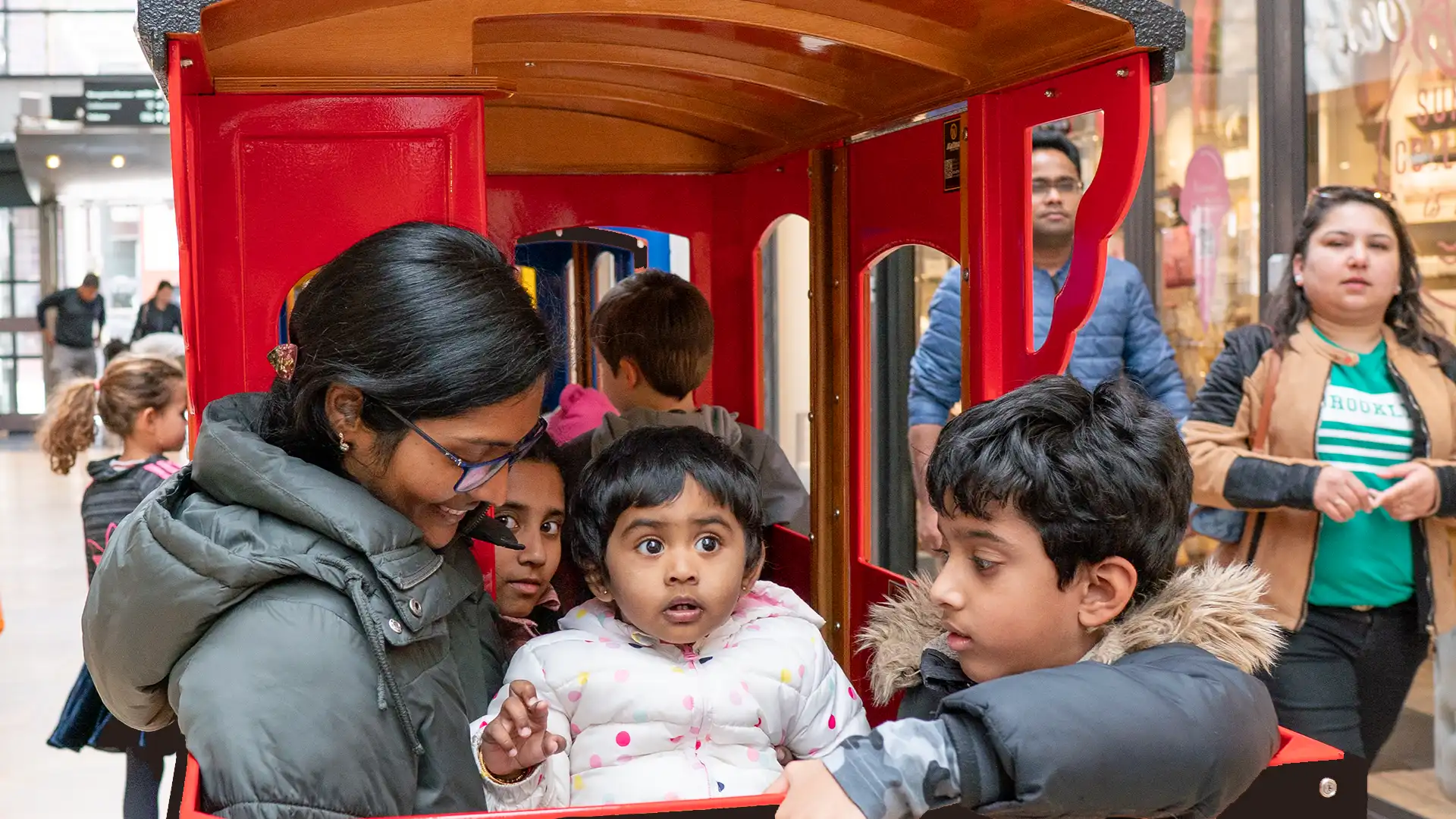
Shopping centers across the United States face a persistent challenge: getting visitors through the doors and keeping them there long enough to spend. In an era where online retail captures a growing share of consumer spending, physical retail needs experiences that cannot be replicated on a screen.
A trackless train shopping center attraction is one of the most effective solutions available. It draws families, creates visibility, generates direct ticket revenue, and measurably extends dwell time. This article explains how it works in practice, based on real US operator experience.
Why Shopping Centers Are Adding Trackless Trains
The fundamental challenge for any shopping center is foot traffic. Every additional minute a visitor spends on property increases the probability of a purchase. A trackless train directly influences both metrics.
Families with young children are among the most valuable demographics for shopping centers. A trackless train gives them a reason to visit, a reason to stay longer, and a positive experience that drives repeat visits. The train becomes a destination within the destination.
Joe Rios of Li'l Grande Trains started his entire business in a shopping mall in Irving, Texas. The train was an immediate draw, generating consistent revenue and attracting attention from other venue operators who saw the concept in action. His operation grew from that single mall concession into one of the most diverse trackless train businesses in the United States.
Revenue Streams
A trackless train in a shopping center generates revenue from multiple sources.
For a detailed look at the return potential, see does a Wattman train make financial sense on our financing page.
Operational Considerations for Indoor Use
Operating a trackless train inside a shopping center requires a unit that is specifically designed for the environment.
The Wattman Mini Express is built for exactly this application. Zero emissions, quiet operation, tight turning radius for navigating corridors and common areas, and compact dimensions that allow operation alongside normal pedestrian traffic.
- Zero emissions: fully electric, no exhaust, safe for enclosed indoor environments
- Quiet operation: no engine noise, operates alongside normal mall ambience
- Tight turning radius: navigates corridors, corners, and common areas without disruption
- Anti-Collision system: integrated safety for high-density pedestrian environments
- Low entry height: designed so young children can board naturally without climbing
- ADA-accessible configurations: ensures compliance with US accessibility requirements
Safety is the non-negotiable element. An indoor environment with high pedestrian density requires a train with certified safety standards. Wattman trains are independently certified to EN 13814:2019, harmonized with ASTM F2291 and F1193 for US commercial operation. That is independently verified safety, not a marketing claim.
The AV Program for Shopping Center Operators
For a shopping center operator or concessionaire, the Assured Value Program simplifies the investment decision.
48 months of full-train warranty coverage means no unbudgeted maintenance exposure during the critical first four years of operation. The guaranteed trade-in value at month 48 means the upgrade path is defined from the start. And financing access through preferred US partners means the investment can be structured to align with the revenue the train generates.
For mall concessionaires: The AV Program turns a trackless train from a capital purchase with unknown long-term costs into a structured investment with defined warranty coverage, a guaranteed residual value, and financing that can be aligned to the revenue the train generates from day one.
This is not standard in the industry. Most trackless train suppliers offer 12 months of drivetrain coverage and leave the rest to the operator. The AV Program was designed for operators who think beyond the first year.
More Than a Novelty
A trackless train in a shopping center is not a novelty. It is a revenue-generating attraction that increases foot traffic, extends dwell time, and creates a competitive advantage that online retail cannot replicate.
If your shopping center is looking for a way to drive visits and create a family-friendly experience that generates measurable returns, this is worth exploring.