In a theme park environment, every attraction competes for guest time. The rides that generate the highest throughput with the lowest operational complexity are the ones that earn their footprint.
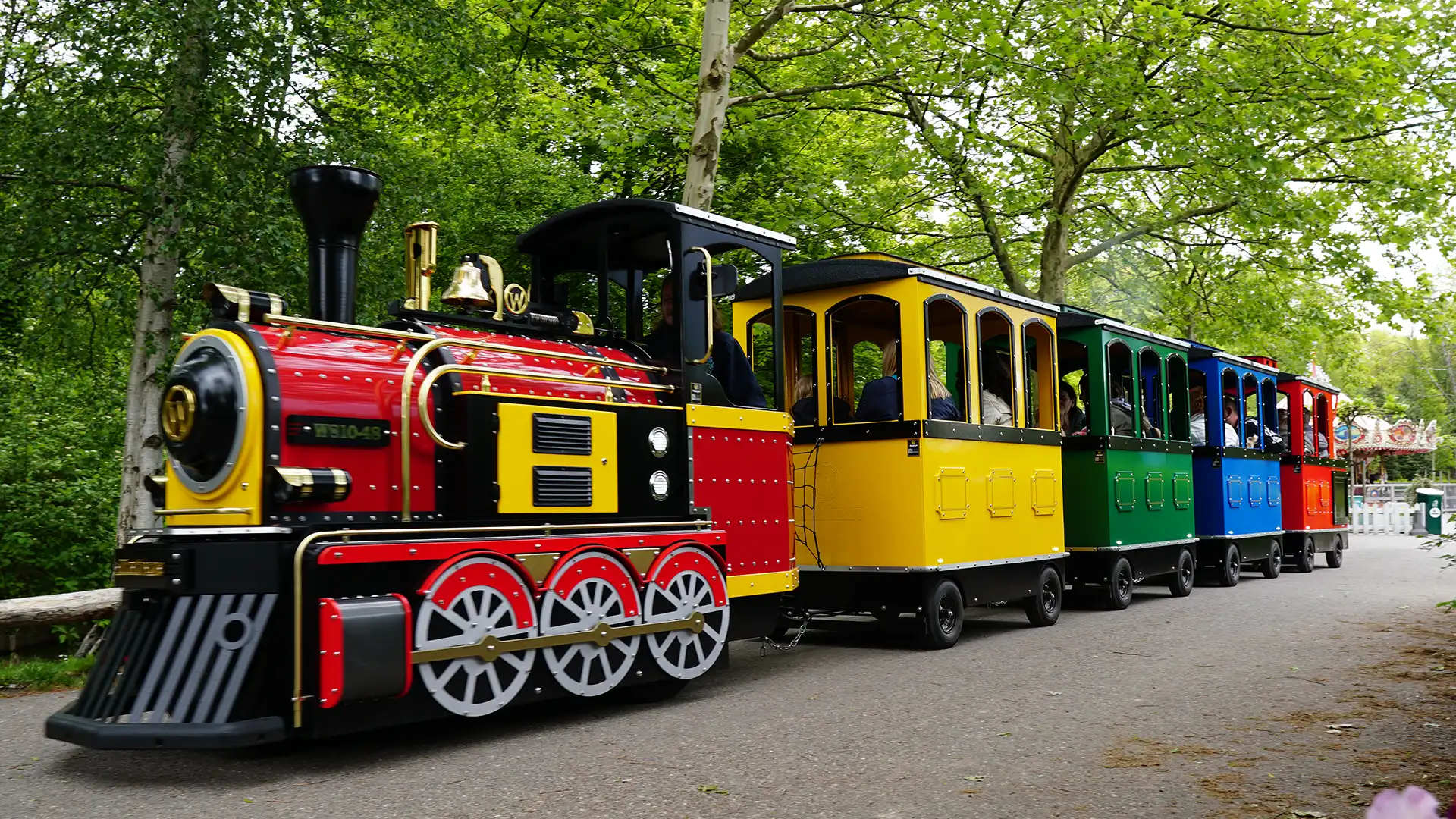
A trackless train theme park attraction occupies a unique position: it serves as both a transportation solution and a revenue-generating experience. It moves guests between zones, reduces walkway congestion, and creates a ticketed ride that adds a direct revenue line without the infrastructure requirements of a fixed-track system.
This article examines how US theme parks and amusement parks are using the Wattman Maxi Express, and what operators should evaluate when adding a trackless train to their attraction mix.
The Dual Role of a Trackless Train
In a theme park, a trackless train serves two functions simultaneously.
Bob Oglesby of Pearl Express Trains at ICON Park in Orlando operates his Wattman trains in exactly this dual role. The trains run daily, serving as both guest transport and a signature experience in one of the most visited entertainment complexes in Florida.
Capacity and Throughput at Scale
Theme parks measure attraction performance in guests per hour. A trackless train's throughput depends on passenger capacity, cycle time, and route length.
For parks with sustained high traffic, multiple trains can run on the same route or on separate routes to multiply throughput. The operational footprint of a trackless train is minimal compared to fixed-track systems: no rails, no switches, no track maintenance.
| Factor | Trackless Train | Fixed-Track System |
|---|---|---|
| Infrastructure | None required (runs on existing paths) | Track installation, switches, maintenance |
| Route flexibility | Changeable, seasonal variations possible | Fixed permanently |
| Installation time | Immediate upon delivery | Months of construction |
| Ongoing maintenance | Vehicle only | Vehicle + track + switches |
Safety in a High-Density Environment
Theme parks are dense, dynamic environments with pedestrians, strollers, wheelchairs, and service vehicles sharing pathways with the train. Safety is not just a priority. It is a condition of operation.
Wattman trains are independently certified to EN 13814:2019, harmonized with ASTM F2291 and F1193 for US commercial operation. The Anti-Collision system is standard. The steering geometry is predictable and tested. The braking system is designed for the operating envelope of a commercial amusement ride.
For theme park operators, this certification matters beyond safety. It impacts insurance premiums, liability posture, and permitting. An independently certified train provides documented proof of compliance that self-certified alternatives cannot match.
The Pearl Express Model
Pearl Express Trains has operated two Wattman units at ICON Park Orlando for over three years. Bob Oglesby chose Wattman based on more than 30 years of engineering heritage and integrated safety features.
"Wattman Trains has been in business for over 30 years. They have all the engineering down, with a lot of built-in safety features. When kids see it, they want to ride it."
Bob Oglesby, Pearl Express Trains
Operating daily in one of the most visited entertainment districts in the United States, the trains demonstrate what sustained high-volume operation looks like. The consistency of performance, day after day, across all weather conditions and guest loads, is the kind of proof that specification sheets cannot provide.
The AV Program for Theme Park Operators
Theme parks run their trains harder than almost any other venue type. Daily operation, year-round, with high passenger loads and continuous cycles. This is exactly where extended warranty coverage delivers the most value.
The Assured Value Program covers the first 48 months under full-train warranty terms. For a theme park that runs its train 300+ days per year, that is approximately 1,200 to 1,500 operating days of coverage. Under industry standard terms, coverage would end at approximately day 365.
The math: Industry standard warranty covers roughly 365 operating days. The AV Program covers approximately 1,200 to 1,500 operating days. For a theme park running daily year-round, that is 3 to 4 times more protected operating time before the warranty expires.
The guaranteed trade-in value and financing access provide the additional layers that make fleet planning predictable. A theme park operator can map out a 4-year replacement cycle with known allocations and defined residual values.
Highest ROI, Lowest Complexity
A trackless train is one of the highest-ROI, lowest-complexity attractions a theme park can add. The key is selecting a unit that is engineered for the demands of daily high-volume operation and backed by a manufacturer that stays involved after delivery.
If you operate a theme park or amusement venue in the United States and you are evaluating a trackless train, we are happy to discuss configurations and coverage.