
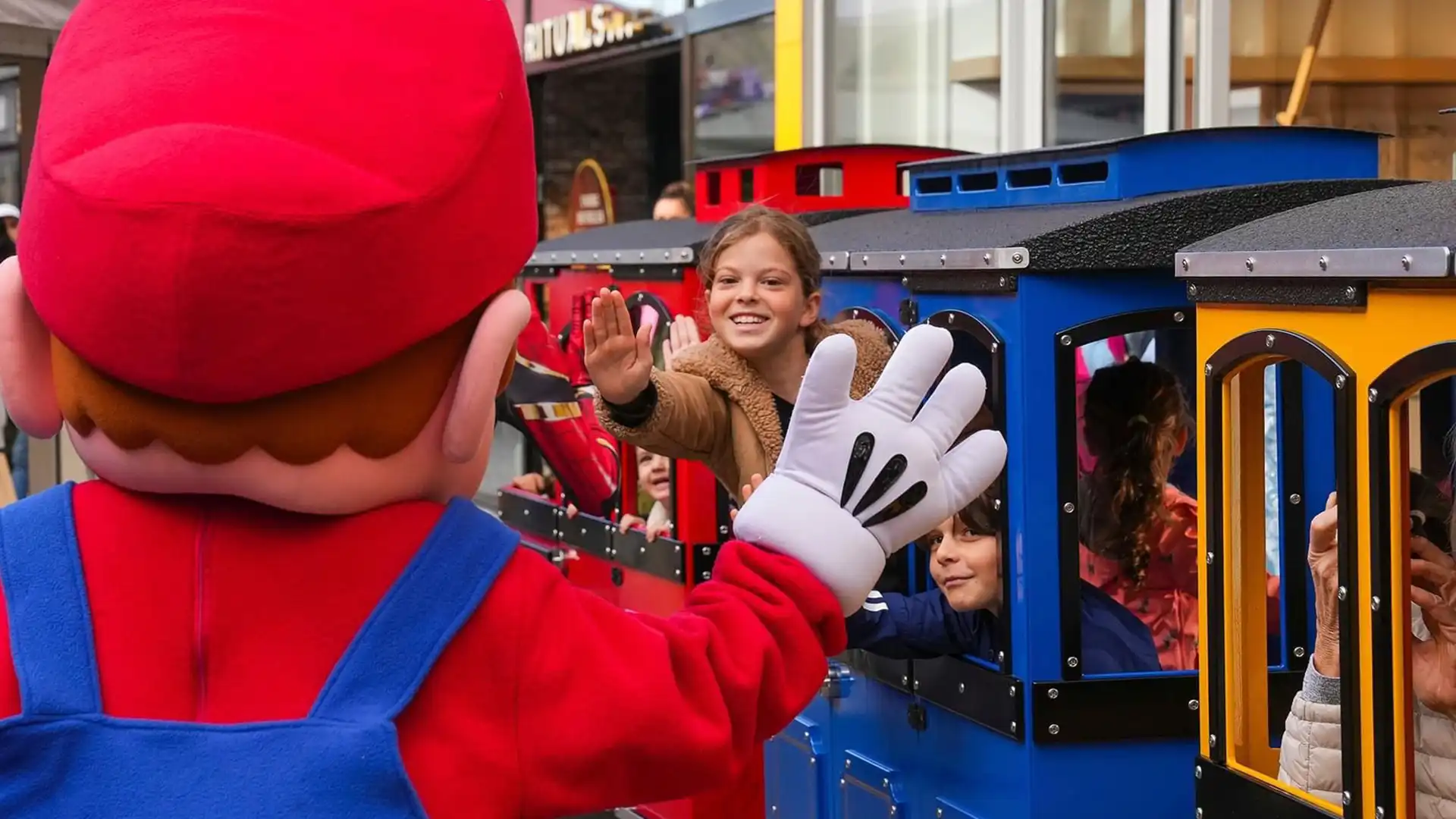
Family entertainment centers are experience businesses. The venues that thrive are the ones that give families a reason to stay longer, come back sooner, and tell their friends.
A trackless train family entertainment center attraction is one of the most effective ways to do all three. It is visible, memorable, photogenic, and it generates direct revenue from the first ride. For FEC operators evaluating their next attraction investment, a trackless train deserves serious consideration.
This guide covers how US family entertainment centers are using the Wattman Mini Express, what to evaluate, and why the ownership framework matters as much as the train itself.
Why Trackless Trains Work in FECs
A trackless train occupies a unique position in the FEC attraction mix. It is accessible to all ages (toddlers through grandparents), requires no height restriction, operates safely in pedestrian environments, and creates visual spectacle without the infrastructure requirements of a roller coaster or fixed-track ride.
- All-ages appeal: toddlers through grandparents, no height restrictions
- Zero emissions: fully electric, safe for enclosed indoor environments
- Quiet operation: operates alongside bowling lanes, arcade floors, and party rooms
- Compact format: tight turning radius for indoor corridors and common areas
- No infrastructure: no track, no rails, no permanent installation required
- Anti-Collision system: standard safety for high-density family environments
Cesar Aguilar of Kiddos ChuChu in the San Francisco Bay Area operates a Mini Express across diverse venues including indoor locations. The train's versatility allows him to serve birthday parties, corporate events, and community festivals with the same unit, adapting to each venue's layout and capacity requirements.
Revenue Model for FEC Operators
Revenue from a trackless train in an FEC comes from three channels.
For a detailed look at the return potential, see does a Wattman train make financial sense on our financing page.
Safety and Certification for Indoor Use
Operating a train inside a building, alongside children and families, requires a unit with documented safety certification. This is not a suggestion. Many insurance providers and landlords require proof of compliance before allowing amusement equipment on their property.
Wattman trains are independently certified to EN 13814:2019, harmonized with ASTM F2291 and F1193 for US commercial operation. The Anti-Collision system is standard. The steering and braking systems are designed for the specific operating envelope of a commercial amusement ride.
For FEC operators: Independent certification simplifies insurance conversations, accelerates permitting, and provides documented proof of due diligence in equipment selection. A self-certified train offers only the manufacturer's word.
The Kiddos ChuChu Model
Cesar Aguilar started with a single Wattman train. He switched from a competitor brand because of reliability issues. After moving to Wattman, he recovered his investment in 14 months and expanded to two trains (a Mini Express and a Maxi Express).
"Wattman offered a more professional setup and better long-term value that you won't be able to find in any other trackless train manufacturer."
Cesar Aguilar, Kiddos ChuChu
His business runs 4 to 5 days per week, with 35 or more rides per day during peak events. The growth was organic, driven by word of mouth from satisfied clients who saw the train at an event and booked their own. For FEC operators considering a trackless train, Cesar's experience is directly relevant. The venues are similar. The revenue model is comparable. And the proof point is clear.
The AV Program for FEC Operators
Family entertainment centers typically operate year-round. The train is in use across seasons, often daily. This is exactly the usage pattern where extended warranty coverage delivers the most value.
The AV Program covers the first 48 months. For an FEC that runs its train 300+ days per year, that is approximately 1,200 to 1,500 operating days of warranty protection. The guaranteed trade-in value at month 48 means the FEC can plan an upgrade cycle that keeps the attraction current and the guest experience fresh.
The warranty investment: The Extended Warranty fee for a Mini Express ranges from $1,250 to $1,500. Given the daily revenue a train generates, the warranty investment is recovered in the first few weeks of operation. The remaining 47+ months of coverage are pure protection.
Not a Novelty. A Revenue Engine.
A trackless train in a family entertainment center is not a novelty attraction. It is a revenue engine, a guest experience anchor, and a competitive differentiator. The operators who treat it that way, and select equipment that matches that importance, are the ones who see the returns.
If you run a family entertainment center in the United States and you are evaluating a trackless train, this is worth a conversation.